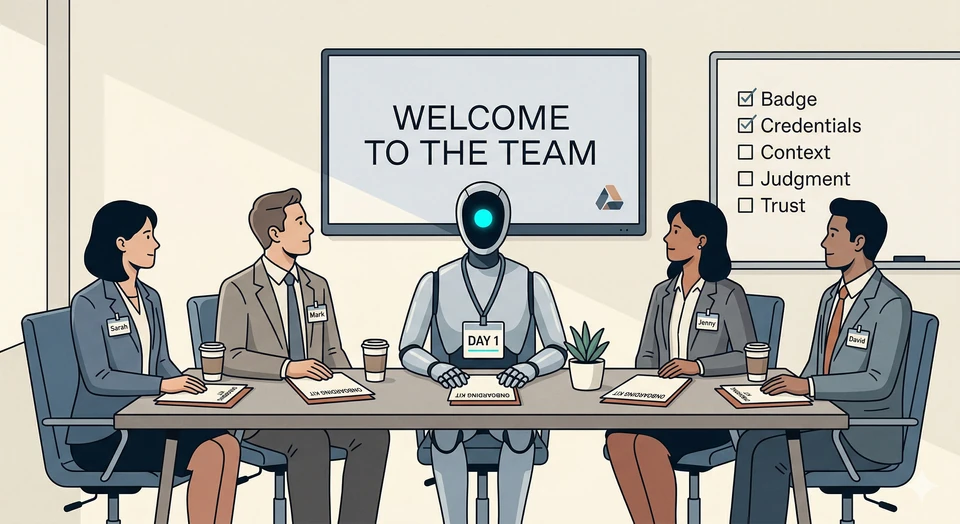
The most expensive mistake in enterprise AI is treating a new agent like installed software instead of a new hire.
The category mistake is hiding in plain sight.
Companies say they are “deploying agents” when what they are actually doing is introducing new operational actors into the company. That sounds like semantics until you notice how much damage the wrong word causes.
Deployment is what you do to software.
Onboarding is what you do to workers.
An agent is not a worker in the legal sense, obviously. But in an operational sense it is much closer to a new employee than to a library update. It will touch systems, interpret context, make local decisions, interact with people, handle exceptions, and sometimes surprise you. The moment that becomes true, the installation metaphor stops helping.
And yet that is still how many organizations behave.
They give an agent access to tools. They feed it a pile of documents. They connect it to a workflow. Then they wait to see whether it behaves. When it fails, they blame the model, the prompt, or “AI immaturity.”
Often the real problem is much more embarrassing.
They skipped onboarding.
What Human Onboarding Actually Does
Most organizations think they know what onboarding is because they remember the visible parts: HR forms, logins, the handbook, the awkward welcome call, maybe a few training sessions that nobody enjoys. But those are just the props. The real function of onboarding is deeper.
It turns access into judgment.
A new employee does not become useful because they can now open the CRM, the ERP, or Slack. They become useful because someone explains what matters, what does not, what “good” looks like, when to escalate, which mistakes are reversible, which ones are career-limiting, and how this particular company actually operates when reality gets messy.
That last part matters more than the formal process map.
Every company has two operating systems. The first is the official one: policies, SOPs, org charts, documented workflows. The second is the real one: exceptions, backchannels, local judgment, informal escalation, tone, risk appetite, and the thousand tiny accommodations that make the machine actually run.
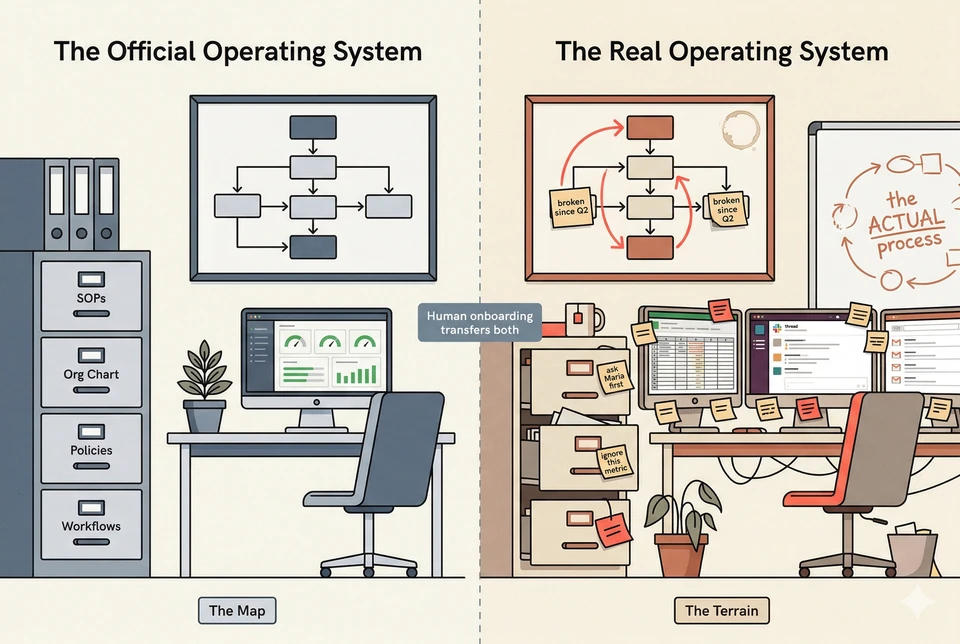
Human onboarding transfers both.
Not perfectly, of course. Sometimes badly. But at least everyone understands that the transfer is necessary. Nobody sane would hire a new operations lead, hand them production credentials, refuse to explain context, and then act mystified when they cause damage on day three.
With agents, people do exactly that and call it innovation.
Why Enterprise AI Keeps Making the Same Error
Because software culture has trained us to think in terms of deployment, not assimilation.
A new piece of software is expected to be deterministic, fully specified, and functionally bounded. If the configuration is correct, it should behave the same way every time. That creates a very seductive mental model for AI systems. Leaders assume the agent is just another software object that needs enough prompt engineering and system integration.
But agents are different in one crucial way: they sit in the gray zone between tool and actor.
They are not independent moral beings. They are not employees. But they are also not passive software in the old sense. They interpret. They choose among possible actions. They deal with incomplete context. They often operate through probabilistic judgment rather than fixed deterministic logic. That means their success depends not just on capability, but on situatedness.
In plain English: where they sit, what they know, what they are allowed to touch, and what they have learned about the local environment.
That is onboarding.
The tragedy is that once you see this, a remarkable number of so-called “AI failures” stop looking mysterious. The agent did not have the right role definition. It did not know where its job ended. It had too much access too early. It never saw enough good examples. It was not taught what to escalate. It was evaluated on output, not on judgment. It learned from a documentation swamp instead of a curated role pack.
Those are not model problems.
Those are onboarding problems.
Deployment Gives Access. Onboarding Gives Judgment.
That line is worth dwelling on because it is the whole argument in miniature.
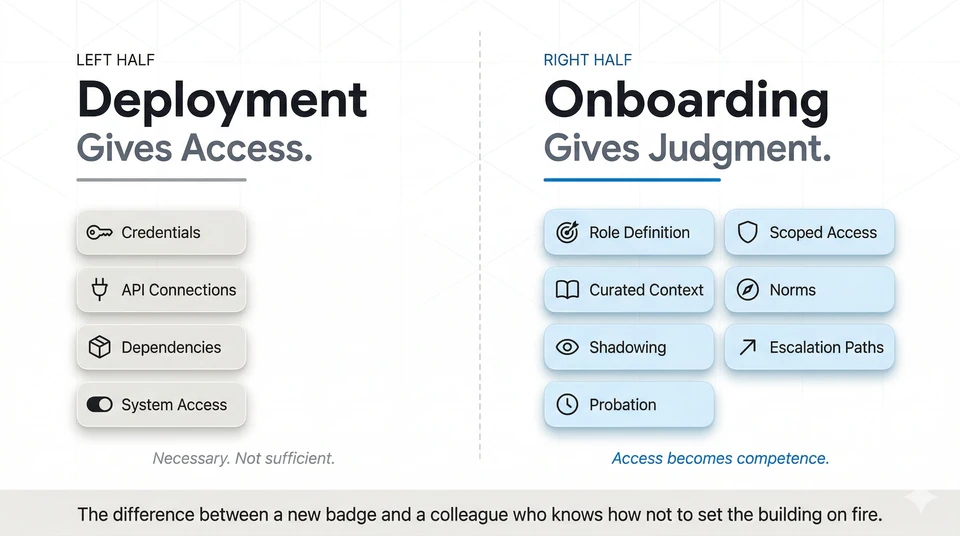
Deployment gives access.
It provisions credentials, connects APIs, installs dependencies, and makes the system technically available.
Onboarding gives judgment.
It clarifies role, establishes norms, defines boundaries, teaches context, transfers examples, specifies escalation paths, and creates a safe path from ignorance to bounded competence.
The difference between those two things is the difference between a new badge and an actual colleague who understands how not to set the building on fire.
This is also why so much enterprise AI theatre feels simultaneously impressive and brittle. The demos focus on capability. The operational reality depends on judgment. A model can be brilliant in general and still be a terrible worker in your company if it has not been properly inducted into the environment.
You can see the same thing with humans. A very smart executive hired into a new firm can make dreadful decisions in the first month, not because they are stupid, but because they have not yet learned the institutional logic. Who has informal influence. Which metrics are real. Which issues are politically sensitive. Which systems are trusted. Which teams always look late because upstream data is broken.
Now imagine skipping that for an agent and then granting it write access.
Madness, really.
The First-Day-at-Work Test

There is a simple thought experiment that instantly exposes whether a company is treating an agent like software or like a worker.
Ask: would we do this to a new human hire?
Would you give them admin rights on day one?
Would you let them make irreversible changes before they had shadowed anyone?
Would you tell them to “just read all the documentation” and assume that counts as understanding the role?
Would you fail to define when they must escalate?
Would you judge them only on whether the output was fast, while ignoring whether the process was safe, explainable, and context-aware?
If the answer is no for humans and yes for agents, then you have not designed an AI operating model. You have recreated the world’s least responsible internship program.
The first-day-at-work test is useful because it cuts through hype and gets back to adult operational judgment. It also reveals something awkward: many organizations are not actually ready for agents because they are not even especially good at onboarding humans.
That is not a reason to avoid the problem. It is a reason to see the opportunity.
The Seven Things an Agent Needs Before It Deserves Autonomy
If we strip away the mystique, serious agent onboarding requires a handful of very concrete things.
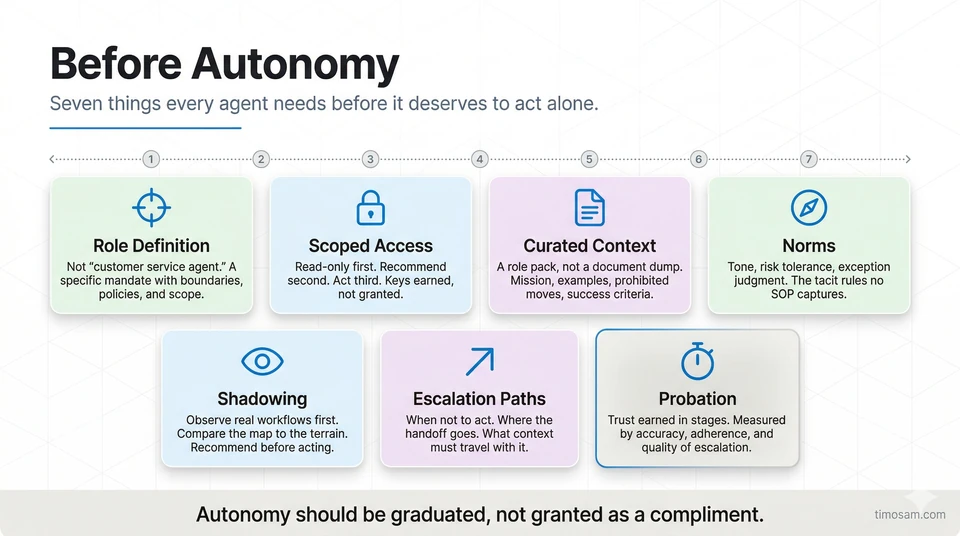
1. A Real Role Definition
“Customer service agent” is too broad. “Triages refund requests under 200 euros, using policy version 4.2, escalating fraud signals and edge cases to a human lead” is a role.
Clarity matters because role ambiguity is dangerous when combined with speed.
2. Scoped Access
An agent should get the minimum viable access required for the current maturity stage.
Read-only first. Then recommendation rights. Then supervised action. Then bounded autonomy where appropriate.
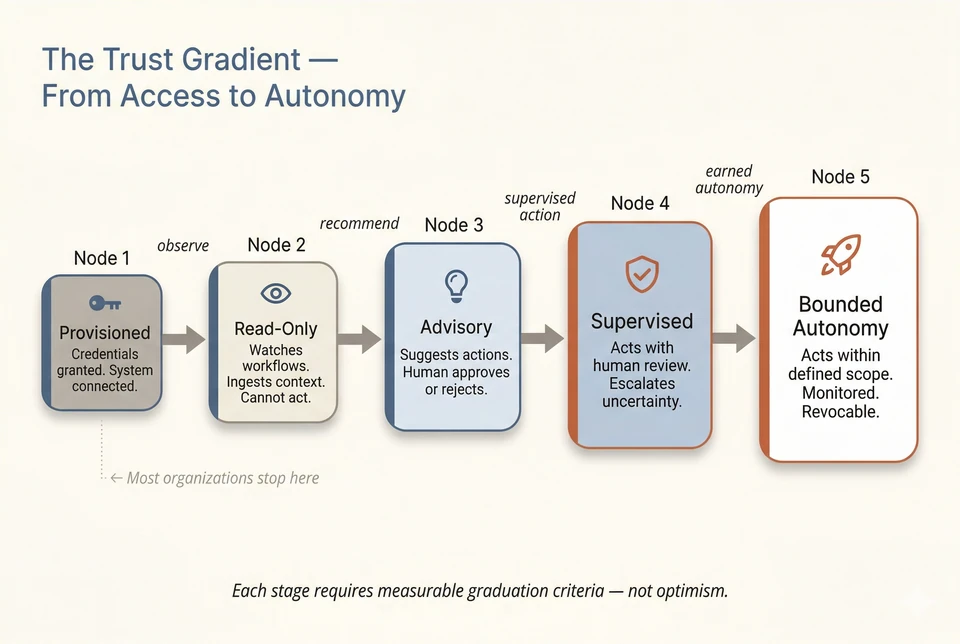
This is not caution theatre. It is the organizational equivalent of not handing the keys to the forklift to the new person before they know where the walls are.
3. Curated Context
Dumping an entire knowledge base into retrieval is not onboarding. It is digital hazing.
Agents need a role pack: mission, examples, allowed tools, prohibited moves, policy boundaries, common exceptions, good outputs, bad outputs, escalation triggers, and what success actually looks like.
4. Norms
This is where most organizations get uncomfortable because norms are often tacit.
What tone is acceptable with customers? What risk is tolerable? What counts as a “small” exception? Which team gets pulled in early when reputational risk appears? How cautious should the role be when the policy is ambiguous but the customer is furious?
These are judgment questions, not documentation questions.
5. Shadowing
Before an agent acts, it should observe.
Let it watch real workflows. Let it compare what the SOP says with what the team actually does. Let it learn where the documented map and the lived terrain diverge. Then let it recommend before it acts.
The fantasy version of AI adoption is immediate autonomy. The sane version is supervised apprenticeship.
6. Escalation Paths
The most dangerous worker is not the inexperienced one. It is the inexperienced one who never asks for help.
Good onboarding teaches not just how to act, but when not to act. If uncertainty, policy risk, reputational stakes, or conflicting inputs appear, the agent needs to know exactly where the handoff goes and what context must travel with it.
7. Probation
Humans get probation. Agents should too.
Trust should be earned in stages, measured against real criteria: accuracy, adherence, exception recognition, quality of escalation, reversibility of action, and consistency under ambiguity.
In other words: autonomy should be graduated, not granted as a compliment.
Why This Is Bigger Than Risk Management
It would be easy to read all this as a cautionary note. “Fine,” says the impatient executive, “we must wrap the agent in process before legal gets nervous.” That is true, but it is not the most interesting part.
The more interesting part is strategic.
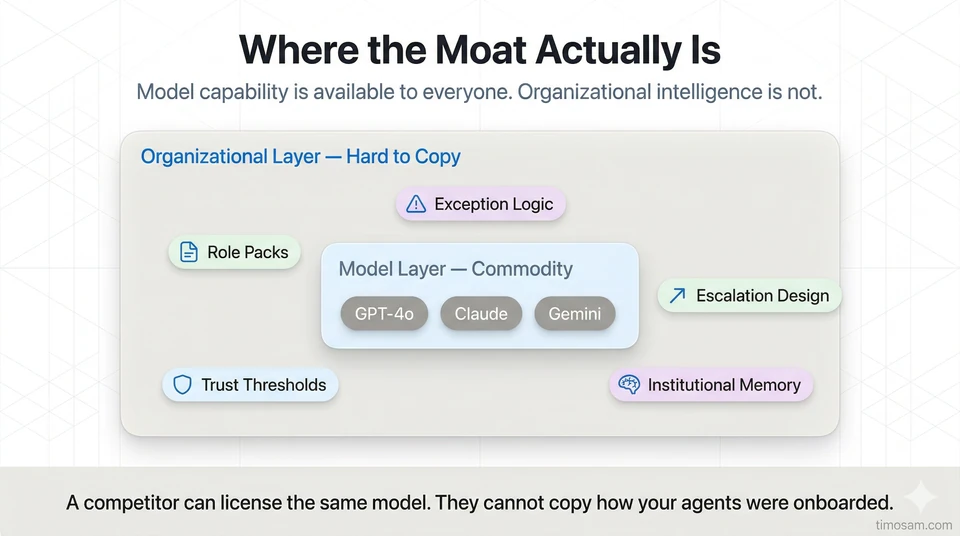
If model capability becomes widely available, then the durable advantage does not come from having access to intelligence in the abstract. It comes from being unusually good at turning that intelligence into trustworthy, situated, role-bound work inside your organization.
That is much harder to copy.
A competitor can license the same model. They cannot instantly copy your role packs, your exception logic, your trust thresholds, your escalation design, your memory architecture, and the local institutional learning embedded in how your agents were onboarded.
This is the overlooked moat.
Everyone is obsessed with the model layer because it feels technological and glamorous. But the sticky value may accumulate in the organizational layer: role design, supervision design, trust infrastructure, and the routines by which a company assimilates non-human workers into live operations.
That sounds less sexy than model benchmarks. Which is exactly why it is likely to matter more.
The Strange Positive Side Effect
There is also a delicious irony here.
To onboard agents properly, companies are forced to clarify roles, clean up permissions, define escalation, document edge cases, make hidden norms explicit, and admit where the real workflow differs from the slide deck. In other words, they are forced to become better managed.
Many firms will discover that their first meaningful AI benefit was not more intelligence. It was less organizational ambiguity.
The agent becomes a mirror.

If the role is incoherent, the onboarding fails. If the policies conflict, the onboarding fails. If nobody agrees who owns the edge cases, the onboarding fails. If the company has been quietly relying on heroic human improvisation instead of operational design, the onboarding fails.
That failure is annoying in the short term. But it is also diagnostic gold.
The organization finally gets to see what was always broken.
The Reframe Leaders Need
So here is the useful shift.
Stop asking: Can the model do the task?
Start asking: Can the agent operate responsibly in this environment?
Those are not the same question.
The first is about capability in a vacuum. The second is about performance inside a living system of tools, people, incentives, norms, and risk.
The first leads you toward demos.
The second leads you toward operating models.
And that is where the future of enterprise AI will be decided. Not by who can make the cleverest prototype, but by who can reliably introduce synthetic workers into real work without creating chaos, opacity, or reputational self-harm.
A Simple Readiness Checklist
Before any agent gets meaningful autonomy, a leadership team should be able to answer yes to seven questions:
- Is the role narrowly and operationally defined?
- Is access staged according to maturity and risk?
- Has the agent received curated role-specific context rather than raw information dump access?
- Are key norms and quality thresholds made explicit?
- Has the agent shadowed real work before acting on its own?
- Are escalation triggers and destinations clear?
- Is there a probation model with measurable graduation criteria?
If the answer is no to several of these, the organization is not really onboarding an agent. It is improvising around one.
That may work for a demo.
It is not a serious basis for enterprise trust.
The Real Bet
The companies that win with agents will not simply be the companies with access to powerful models.
They will be the companies that learn a new discipline earlier than everyone else: how to onboard agents into roles, teams, and operating environments with the same seriousness they once reserved for high-trust human hires.
Eventually, much of this onboarding will become systematic. Infrastructure will provision permissions, load role packs, attach policy boundaries, instantiate memory scaffolds, monitor behavior, and route supervision automatically. But the core idea will remain the same.
An agent is useful not when it is switched on.
An agent is useful when it has been inducted into the logic of the organization well enough to act without causing organizational surprise.
That is not deployment.
That is onboarding.
And once you see it, it becomes very difficult to tolerate the old way of doing things.