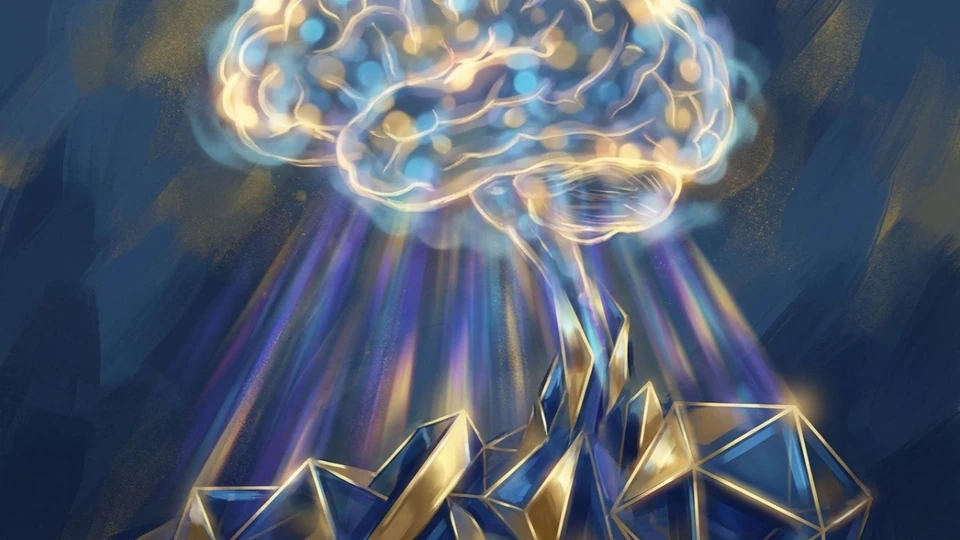
“The real problem is not whether machines think but whether men do.” — B.F. Skinner
The real answer is: men think. Machines implement. The gap between them is where value dies.
I. The Confession
Let’s start with what the technologists won’t say.
Consciousness is not a function.
You cannot compress qualia. You cannot abstract phenomenal experience into a reusable module. The redness of red, the ache of longing, the electric clarity of insight—these are not information-theoretic objects. They don’t have Kolmogorov complexity because they aren’t strings. They aren’t representations of anything. They are the ground from which all representation emerges.
Every serious philosopher knows this. Chalmers called it the Hard Problem for a reason. Nagel asked what it’s like to be a bat, and no functional description answers him. Searle’s Chinese Room still has no one home, no matter how sophisticated the lookup tables.
The reductionists keep trying to dissolve consciousness into computation. They keep failing. And they’ll continue failing, because the project is confused from the start. You can’t reduce the reducer.
So let’s stipulate: consciousness is primary. It is the locus of meaning, the source of intentionality, the arena where anything matters at all. Without it, there’s no “for whom” value exists. Just physics doing physics.
Now.
Having stipulated that, let me tell you why tools like Cursor might be the most important technology since the invention of writing.
II. The Ancient Bottleneck
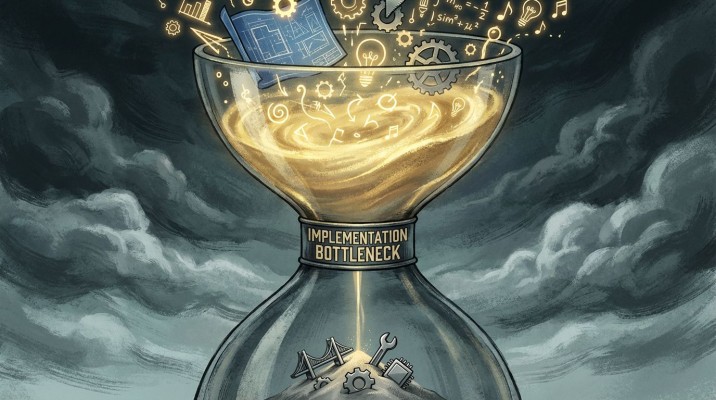
Here’s the tragedy of human history in one sentence:
Conscious insight is infinite. Implementation bandwidth is finite.
Every person who has ever lived has had ideas they couldn’t actualize. The architect who sees the building but can’t draft. The entrepreneur who grasps the market gap but can’t code the solution. The teacher who understands exactly what the student needs but can’t clone herself. The visionary who perceives the future but can’t reach through time to build it.
Consciousness sees. But seeing isn’t sufficient. To change the world, you need to translate the seen into the structured—into forms that persist beyond the moment of insight, that can be transmitted, repeated, and scaled.
Those persistent, transmissible, repeatable structures? We can call them many things:
- Tools
- Processes
- Institutions
- Systems
- Artifacts
But the most precise term, the one that captures their essential character, is functions.
Not in the reductive sense—we’re not saying consciousness IS functions. We’re saying consciousness PRODUCES functions. They are the crystallized precipitate of conscious intent. The residue that remains when insight meets implementation.
And for all of human history, producing that residue has been agonizingly slow.
III. The Function-Generation Stack
Every act of bringing something new into the world follows the same basic stack:
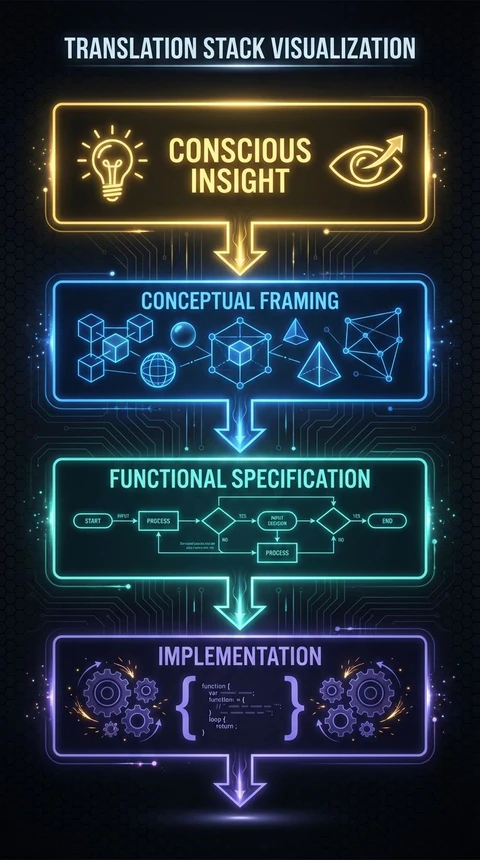
The insight was perfect in consciousness. But words couldn’t capture all of it. The conceptual model was crisp, but the specification missed edge cases. The specification was complete, but the implementation had bugs.
By the time a conscious insight becomes a running function, it has passed through so many lossy translations that it barely resembles its source. Ask any founder who’s shipped a product: that thing is not what they originally envisioned. It’s a shadow. A compression artifact. A ghost.
The gap between consciousness and implementation is where most human value goes to die.
IV. The History of Bandwidth Expansion
All technological progress can be read as attempts to widen the implementation bottleneck.
Writing allowed conscious insight to persist beyond the moment. Ideas could travel through time. But translation into text remained laborious.
Printing allowed implementations to scale. One manuscript became a thousand books. But creating the manuscript was still a manual craft.
Bureaucracy created institutional functions—procedures that could be executed by interchangeable humans. The organization became a machine made of people. But designing the procedures required elite expertise.
Programming allowed functions to be expressed in pure logic, executable by machines. Suddenly, implementation costs collapsed—once something was coded, it could run billions of times at near-zero marginal cost. But the coding itself remained a bottleneck. It required years of training. It was error-prone. And it created a priesthood of those who could translate, and a laity of those who could not.
No-code tools tried to eliminate the priesthood. They failed. They didn’t remove complexity; they hid it. And hidden complexity is just delayed complexity. Eventually, you hit the walls of what the pre-built components could do, and you’re back to needing the priests.
Which brings us to now.
V. The Agentic Breakthrough
What makes tools like Cursor, Claude Code, Copilot, and agentic programming systems different?
It’s not that they write code. Code generation has existed for decades.
It’s not that they understand natural language. That’s necessary but not sufficient.
It’s that they collapse the translation stack.
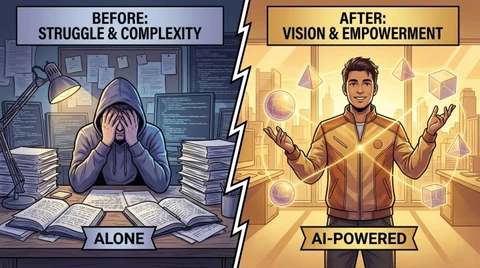
For the first time in human history, you can operate primarily at the level of conscious intent—describing what you want, why you want it, what problem you’re solving—and have the lower layers of the stack handled for you.
Not perfectly. Not yet. But directionally, the implementation barrier is dissolving.
Consider the old workflow:
- Have insight
- Translate to requirements document
- Translate to technical specification
- Translate to system architecture
- Translate to code
- Debug code
- Iterate through steps 4-6 approximately 47 times
- Ship something that sort of resembles the original insight
Now consider the agentic workflow:
- Have insight
- Describe it
- Iterate with the agent until it works
- Ship
The middle layers haven’t disappeared. They’ve been automated. The translation still happens—but it happens at machine speed, with machine patience, with machine consistency.
This is the removal of a constraint that has bound human civilization since its inception.
VI. Why “Functions” Is the Right Frame
Let’s be precise about terminology.
When I say agentic tools generate “functions,” I mean something very specific:
A function is a bounded transformation that takes inputs, applies logic, and produces outputs—deterministically, repeatably, and independently of the consciousness that conceived it.
Functions are:
- Persistent: They exist after you stop thinking about them.
- Callable: Others can invoke them without understanding their internals.
- Composable: They can be chained with other functions.
- Scalable: They can execute millions of times with no additional effort.
Consciousness has none of these properties. Your insight dies when you stop attending to it. Your understanding cannot be directly invoked by others. Your intuitions don’t compose modularly. Your cognition doesn’t scale beyond one brain.
This is not a criticism of consciousness. It’s a description of its nature. Consciousness is irreducible and irreplaceable. But it is also non-transferable and non-scalable.
Functions are how consciousness projects power beyond itself.
Every tool you’ve ever used—from a hammer to a spreadsheet—is a crystallized function that extends your will into the world. The more functions you can create, the more your conscious intentions can manifest in reality.
Agentic programming tools are function factories. They take conscious intent as input and produce functions as output. They are, in a very real sense, implementation itself, available as a service.
VII. The Reduction of Intelligence to Implementation
Here’s the claim that sounds provocative but is actually just accurate:
For practical purposes, the valuable component of intelligence is its capacity to generate functions.
Not intelligence itself. Intelligence is broader than that—it includes understanding, appreciation, judgment, wisdom. These are intrinsically valuable and not reducible to function-generation.
But when we ask “what can intelligence DO in the world?”—when we move from the intrinsic to the instrumental—the answer is: generate functions. Solve problems repeatedly. Create tools others can use. Implement solutions that persist.
This is why the Turing Test never satisfied philosophers. A machine that generates convincing text might pass behavioral tests, but so what? The question was never “can machines produce outputs indistinguishable from humans?” The question was “is there consciousness behind the behavior?”
For most practical purposes, it doesn’t matter.
If an agentic system can take your conscious intent and translate it into working functions—software that runs, systems that operate, tools that work—then the question of whether the system is “truly intelligent” is philosophically interesting but pragmatically irrelevant.
You don’t need artificial consciousness. You need artificial implementation. You need a system that can traverse the function-generation stack faster than any human team.
That’s what agentic tools provide. And that’s why they’re the next big thing.
VIII. The New Topology of Work

If agentic tools reduce intelligence to implementation, what happens to human work?
The answer isn’t “automation replaces humans.” That’s too simple. The answer is that the topology of value creation changes.
Previously, value was created across the entire stack:
- Visionaries at the top (rare, valuable)
- Translators in the middle (abundant, commodity)
- Implementers at the bottom (skilled but scalable)
The middle layer—product managers, architects, tech leads, senior developers—existed primarily to translate up and down the stack. To take vision and make it technical. To take technical constraints and make them legible to vision.
Agentic tools collapse the middle.
When you can speak directly to an implementation engine in natural language, what’s the product manager’s job? When the agent handles architecture decisions, what’s the tech lead doing? When iteration cycles drop from weeks to minutes, what’s the purpose of elaborate planning processes?
The new topology:
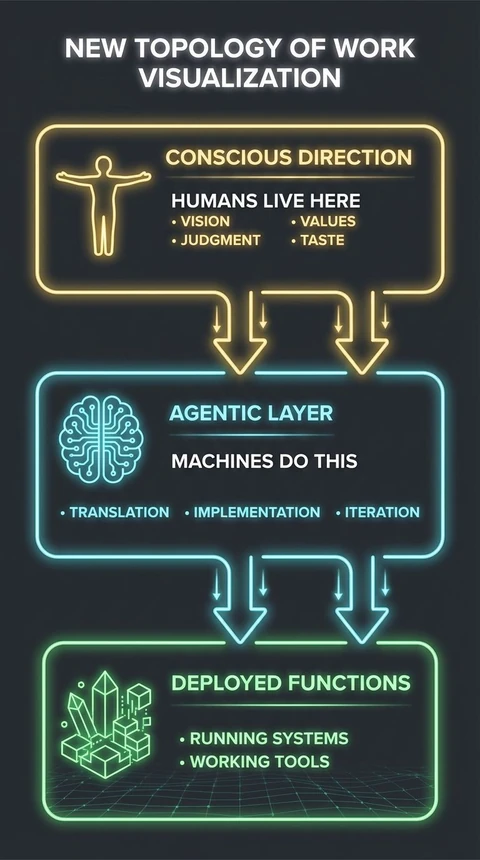
The human role shifts entirely to the top of the stack: setting direction, making judgments, providing the conscious intent that gives the whole process meaning.
This is not humans becoming obsolete. This is humans becoming essential in a way they haven’t been before—as the source of purpose, not the mechanism of execution.
IX. The Philosophical Irony
Here’s the delicious paradox:
The reductionists are wrong about consciousness. It cannot be eliminated. The Hard Problem is real. Machines are not going to wake up just because they get better at generating functions.
But the reductionists are right about something else: for functional purposes, you don’t need consciousness to be reducible. You just need functions to be generable.
The philosophical problem and the engineering problem are orthogonal. We can build systems that produce perfect functions without having any idea how consciousness works. We don’t need to solve the Hard Problem to build Cursor. We just need to solve the implementation problem. And that problem? That’s tractable. We’re solving it right now.
Consciousness remains mysterious. Implementation becomes trivial. The gap between them stops mattering for practical purposes.
This is why the philosophical debate—important as it is—is somewhat beside the point for understanding why agentic tools matter. You don’t have to believe machines can be conscious to recognize that they can implement. You don’t have to reduce mind to matter to use matter to extend mind.
The tools work. The functions generate. The implementations deploy. Whether there’s phenomenal experience behind the process is a question for philosophers. For practitioners, the question is simpler: does it work?
It does.
X. What This Means For You
If you’ve followed the argument this far, the implications should be clear:
1. Your value is in consciousness, not implementation
Stop competing with machines on implementation speed. You will lose. Instead, cultivate what machines cannot replicate: judgment, taste, wisdom, purpose. The conscious qualities that determine what should be built, not just how to build it.
2. Learn to direct, not execute
The skill of the future is articulating conscious intent clearly enough that agentic systems can implement it. This is not “prompt engineering” in the trivial sense. It’s the capacity to specify what you actually want—which requires knowing what you actually want. Most people don’t.
3. Embrace the function-generation paradigm
Think in terms of functions. When you solve a problem, ask: “Can this solution be abstracted into something reusable?” When you encounter friction, ask: “What function would eliminate this?” When you envision the future, ask: “What functions don’t exist yet that would make this possible?“
4. Develop meta-judgment
As function generation becomes cheap, function evaluation becomes expensive. Anyone can generate a hundred implementations. Who decides which one is right? Who catches the subtle misalignments between intent and artifact? Who notices when the function technically works but spiritually fails? That’s judgment. That’s human. That’s valuable.
5. Use the tools
This isn’t abstract. Cursor exists. Claude Code exists. Agentic workflows exist. You can, today, collapse your implementation stack by an order of magnitude. The people who adopt this first will have an advantage that compounds. The people who don’t will be implementing functions by hand while their competitors generate them by conversation.
XI. The Function at the End of History
Let me close with a speculation.
If agentic tools continue to improve—if the implementation bottleneck continues to widen—then the asymptotic state of human civilization is one where function generation approaches zero marginal cost. Any function that can be specified can be implemented. Instantly. Perfectly. The translation stack collapses to nothing.
In that world, what remains?
Only consciousness. Only the irreducible core. The part that specifies, judges, appreciates, means. Technology will have done its job: extending conscious will infinitely into the world. Every intention immediately manifested. Every vision instantly real.
And then the question becomes: what do we intend? What do we value? What do we actually want? These are not technical questions. They’re not implementation questions. They’re questions only consciousness can answer.
The function-generation paradigm doesn’t diminish consciousness. It reveals consciousness as the only thing that was ever truly scarce.
Everything else was just waiting for the tools to catch up.
XII. The Call
Cursor, Anthropic Claude, Google Antigravity and their descendants are not just productivity tools. They are not just “AI assistants.” They are not incremental improvements on IDEs.
They are the first technologies in human history that directly address the implementation bottleneck—the ancient gap between what consciousness can envision and what hands can build.
They reduce intelligence, for practical purposes, to function generation. Not because intelligence is function generation, but because function generation is the externally useful output of intelligence. The part that scales. The part that persists. The part that can be shared.
This is the next big thing because it’s the only big thing. Everything else is downstream.
The revolutions in software, in business, in science, in art—they’re all waiting on the other side of the implementation threshold. Waiting for the moment when “I can imagine it” and “it exists” become the same statement.
We’re not there yet. But we can see it from here.
The tools are ready. The functions are waiting. The only question is what consciousness will choose to build.
That’s on you.

Originally published on LinkedIn.